

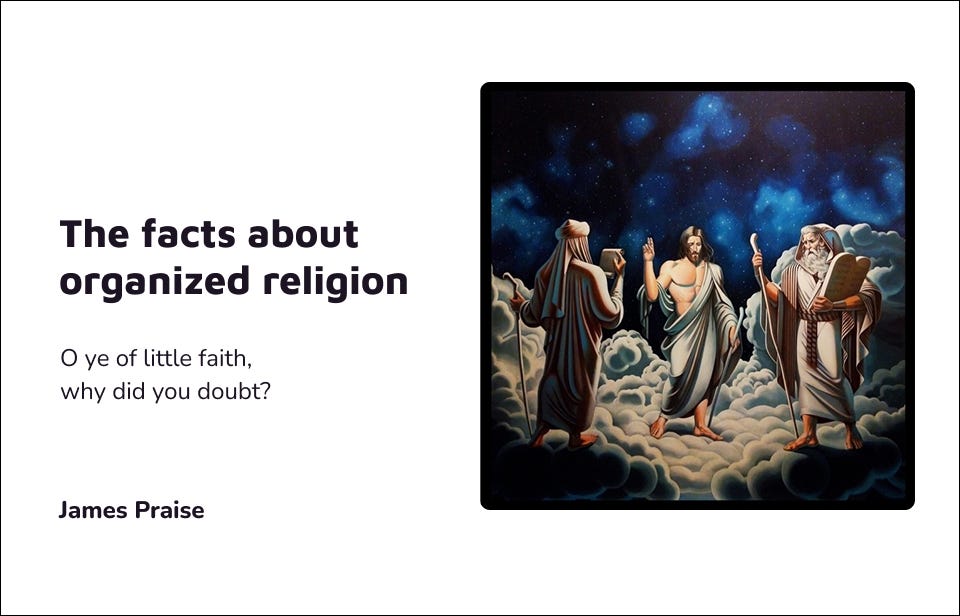
The Prophets Muhammad, Jesus and Moses. Image credit: Yalçın Bilgin
Worldviews and faith
We need to recognize that religion is based on faith.
As a Christian, you might believe that the Bible is the book that tells you everything about life, and that its stories are the standard and the only truth. The idea of Jesus Christ, the Holy Spirit, and God—everything that comes from that foundation—shapes your belief system and worldview.
So naturally, you see everything through that Christian lens, maybe even the specific denomination you belong to, based on what you’ve been taught and the messages you’ve heard. But maybe you also need to consider that not everyone shares that same faith, church, or even reads the same Bible.
There are people who are Muslim, Hindu, Buddhist, or who simply choose not to practice any religion at all. Some people live based on morality, empathy, human values, and respect for others—not doctrine. People have their own ideologies about how to live.
Most people follow the faith they were born into. Their parents practiced it, they grew up in that environment, and their entire community revolves around it. So it’s not easy to question or leave it. There isn’t sufficient incentive.
Human agency and spiritual forces
Many ideologies of faith require the surrender of human agency to powers beyond your direct control. For example, we might say:
“God did it” – when good things happen to us, and we want to give a testimony.
“It’s the devil, not me”, “It’s the evil spirits”, “It’s my village people”, “It’s the powers of my father’s and mother’s house” – when we do not want to take responsibility, or be accountable for our actions when we do bad things / the wrong things.
This mindset makes it seem like human beings have no power or agency, and that we’re all helpless.
If we say everything is driven by spirits, then no one should be held accountable for anything. If someone shoots me with a deadly weapon on the street and takes my life, we shouldn’t blame the shooter because “a spirit” influenced him, right? It means we can’t hold anyone responsible for their actions.
It also means we shouldn’t bother trying to fix anything, study, work, or build—since everything is supposedly controlled by spirits.
That kind of belief limits human potential.
When we ascribe everything to unseen spirits, it creates hopelessness. It removes accountability. If a road in front of my house is bad, and cars keep getting damaged, we can either pray or fix the road. If I mobilize my community to pool resources and fix it, and someone else chooses to stay home and pray, who really solved the problem?
If, after we fix it, that person comes to say it was their prayer that did it—it sounds delusional. It’s unfair to those who actually acted. And that’s why faith-based reasoning doesn’t always resonate with others, because it dismisses human effort.
What did the Bible say about faith without works? It died, it is dead, and it is still dying! James 2:14–26.
Believing that humans are powerless and incapable without divine intervention makes it impossible to take real action. And insisting that prayer alone fixes everything alienates people who don’t share your faith.
In fact, this is why I wrote a letter to the church in 2023.

If we truly want to build society, we have to communicate on a practical, inclusive level—beyond religion, tribe, or personal belief.
The facts about organized religion
Since the beginning of humanity, people have sought reasons for the creation of our world and our intelligent species. This gave rise to structures of beliefs and practices that were later defined as religion.
Religion is a system of belief that organizes communities, giving them a framework for understanding the world and for collective behavior.
French sociologist Émile Durkheim (one of the principal architects of modern social science), argued that religion is the most fundamental social institution, and, in one form or another, will always be a part of social life.
Population growth, through history, has been inextricably tied to the expansion of religious life. Today, some 85 percent of people around the globe identify with a religion.
Religions that we’re born into
Most people adopt the religion of their parents by birth, inheriting beliefs, rituals, and identity through cultural and familial transmission long before making personal spiritual choices.
In fact, the majority of people remain in the religion they were born into, never formally questioning or changing their inherited faith tradition.
While there are around 10,000 distinct religions in the world, over three-quarters of the global population adheres to one of these four – Christianity (31%), Islam (25%), Hinduism (15%), and Buddhism (7%).
Religious spread is driven by a combination of factors including missionary work, trade, migration, conquest, and political support, allowing beliefs to move across cultures and regions.
Over time, religions also grow by adapting to local cultures, offering spiritual meaning, community belonging, or perceived benefits in daily life.
Abrahamic religions
The Abrahamic religions—Judaism, Christianity, and Islam—are monotheistic faiths that trace their spiritual lineage to the patriarch Abraham and collectively represent the largest religious tradition in the world.
Christianity, with over 2.4 billion adherents, is the largest, spanning Roman Catholicism, Protestantism, and Eastern Orthodoxy.
Islam follows with more than 1.9 billion Muslims, divided primarily between Sunni and Shia branches, and is the fastest-growing major religion globally.
Judaism, the oldest of the three, has around 15 million followers, mostly concentrated in Israel and the United States.
The global spread of these three religions has significantly shaped history, politics, culture, and interfaith relations across continents for thousands of years.
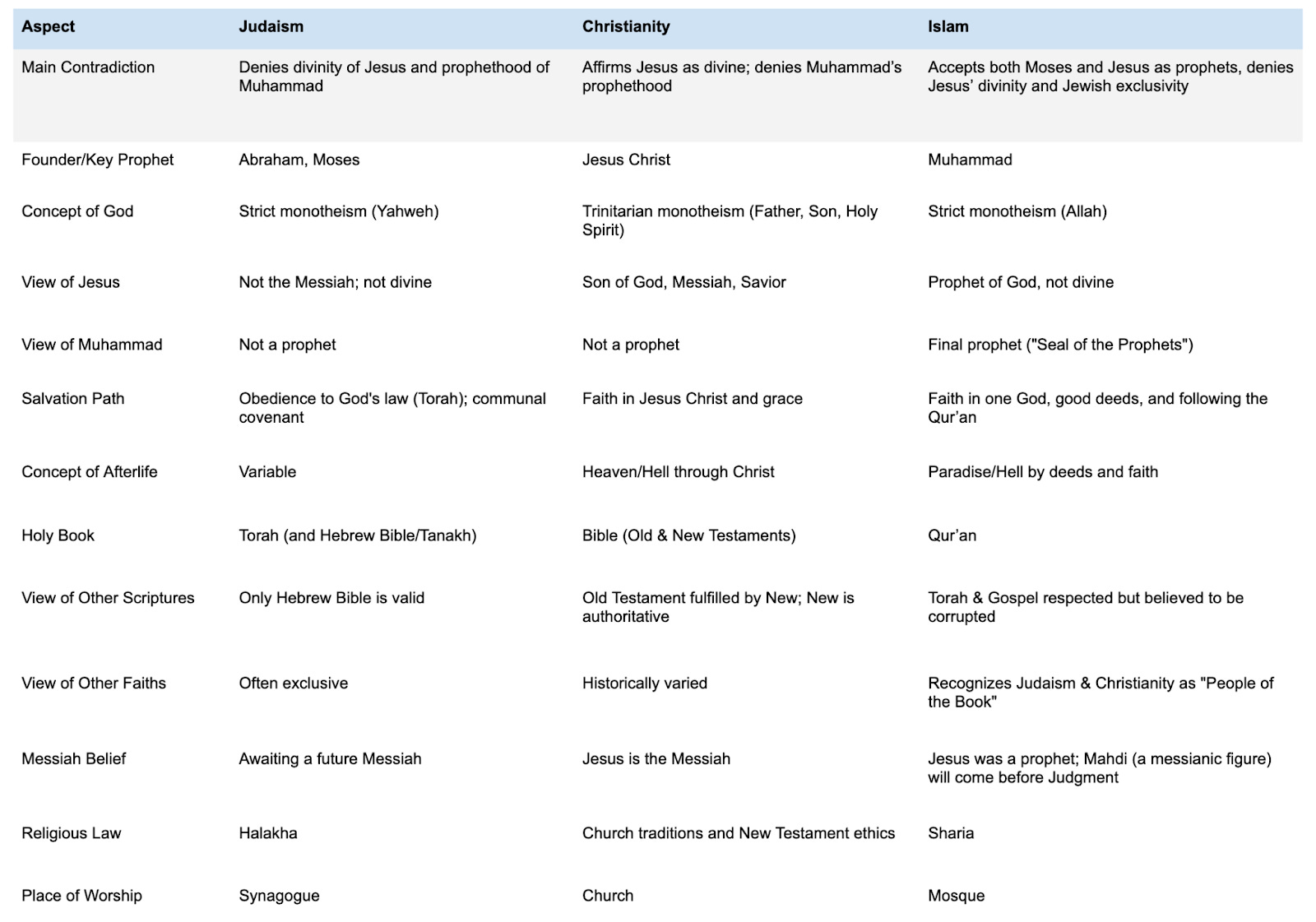
The three Abrahamic religions—Judaism, Christianity, and Islam—share a common origin in the patriarch Abraham and uphold belief in one God, yet they diverge significantly in theology, scripture, and understanding of divine revelation.
Judaism emphasizes a covenant between God and the Jewish people, with the Torah as its foundational text.
Christianity builds upon Jewish scripture but centers on Jesus Christ as the Son of God and savior, a claim Judaism rejects.
Islam regards both Moses and Jesus as prophets but sees Muhammad as the final and most complete messenger, with the Qur’an as God’s final word.
These differences create contradictions:
Christians view Jesus as divine, while Muslims and Jews consider this blasphemous;
Muslims accept the earlier scriptures but claim they were corrupted;
Jews and Christians reject the Qur’an’s authority altogether.
If all three claim truth from the same God yet fundamentally disagree, especially on who speaks for Him, how can one know which—if any—is truly divine?
Christian divisions
While Christianity is united in its belief in Jesus Christ as the Son of God and Savior, it has fragmented over centuries into multiple denominations due to theological disputes, interpretations of scripture, authority structures, and cultural differences.
Despite their common foundation, many denominations differ on issues such as the authority of the Pope, the nature of communion, baptism, and the interpretation of the Bible—sometimes to the extent that they question each other’s legitimacy.
There are over 45,000 Christian denominations worldwide, reflecting a wide spectrum of doctrines, leadership structures, and worship practices. These include:
Roman Catholicism
Eastern Orthodoxy
Protestantism
Anglicanism (Church of England)
Pentecostalism & Evangelicalism (within Protestantism)
Seventh-day Adventists
The Church of Jesus Christ of Latter-day Saints (Mormons)
Jehovah’s Witnesses
African Indigenous Churches (AICs)
A common thread among many of these groups is that their founders or General Overseers often originated from other Christian denominations. Motivated by doctrinal disagreements, theological convictions, or new revelations, they broke away to establish new movements with distinct teachings and practices.
Yet, millions of churchgoers worldwide believe their church doctrine is superior to the next person, and they are the only ones going to heaven—or whatever their idea of salvation is.
If Christians themselves interpret the message of Jesus in such divergent and conflicting ways, which—if any—represents the true continuation of his teachings?
Islamic divisions
While Islam is united in its belief in Allah as the one true God and Muhammad as His final prophet, it has divided over centuries into multiple sects and schools of thought due to theological disagreements, political conflicts, interpretations of scripture, and cultural variations.
Despite sharing the Qur’an, the Prophet Muhammad, and the Five Pillars of Islam, various sects often disagree on how leadership should be structured, which Hadiths (sayings of the Prophet) are authentic, and how religious rulings should be applied—sometimes to the point of challenging each other’s legitimacy as true Muslims.
There are over 70 Islamic sects worldwide, reflecting a wide spectrum of beliefs, legal schools, and spiritual approaches. These include:
Sunni Islam (with its four major schools: Hanafi, Maliki, Shafi’i, Hanbali)
Shia Islam (with major branches like Twelvers, Ismailis, Zaidis)
Sufism (a mystical dimension found across Sunni and Shia communities)
Ibadi Islam (mainly in Oman and parts of East Africa)
Ahmadiyya (a reformist movement often rejected by mainstream Muslims)
Salafism / Wahhabism (strict interpretations found in parts of the Arab world)
Nation of Islam and other reformist movements (mostly in the West)
A common thread among many of these groups is that their founders, imams, or reformers were originally within mainstream Islamic circles but broke away due to disagreements about succession, divine authority, or new revelations. Some movements formed out of political crises, others from spiritual reform, and many through interpretive disputes.
Yet, just as in Christianity, millions of Muslims believe that their sect, legal school, or interpretation of Islam is the most authentic, and sometimes view other groups as misguided or even heretical.
If Muslims themselves, while professing loyalty to the same Prophet and Book, interpret the message of Islam in such divergent and sometimes conflicting ways, the question arises: Which—if any—represents the true continuation of the Prophet’s message?
The search for meaning
There are a number of alternative ideologies that people who are deconstructing their paternal and maternal religions are currently exploring. A lot of this search for meaning is motivated by disillusionment, spiritual trauma, colonial legacies, or a hunger for authenticity.
Some of these alternative ideologies include; Atheism, Agnosticism, African Spirituality, Spiritual Awakening, Numerology, Esoteric Spirituality, Astrology & Cosmic Spirituality, etc.
Atheism: Rejects belief in any deity, favoring reason, evidence, and secular ethics.
Agnosticism: Holds that the existence of God or the divine is unknown or unknowable.
African Spirituality: Emphasizes ancestral connection, nature-based rituals, and communal harmony.
Spiritual Awakening: Focuses on personal transformation, inner healing, and expanded consciousness.
Numerology: Believes numbers carry symbolic and spiritual significance that guide destiny.
Esoteric Spirituality: Pursues hidden knowledge, archetypes, and mystical insight through symbols and ritual.
Astrology & Cosmic Spirituality: Views celestial bodies as influencing human personality and life events.
All these ideologies prioritize personal agency, inner truth, and non-institutional pathways to spiritual meaning.
Are you religious, spiritual, or just trying to make sense of life?
Conspiracy theories
There are also a number of conspiracy theories that have developed from mistrust in institutions, gaps in knowledge, or perceived inconsistencies in official narratives.
Some of these theories include:
the belief that secret societies like the Illuminati run the world,
world leaders are actually shape-shifting reptilian aliens controlling the Earth,
the moon landing was faked,
vaccines are a tool for population control,
climate change is a hoax,
COVID-19 was engineered for global control,
5G technology is used to manipulate thoughts, and
governments hide evidence of alien life.
Conspiracy theories matter because they often reflect real fears and systemic issues, and sometimes, they turn out to be true or partially true, exposing previously hidden truths.
It is therefore important to use some framework to critically evaluate the validity, risk, and intent behind any conspiracy theory – whether it’s about religion, politics, technology, health, or society.
My view on religion, spirituality, and God
Religion is one of many answers to the fundamental question of existence.
I have been deconstructing systems from first principles and I have found that the following forces are the drivers of religion and its substitutes:
Human desire for meaning: Humans seek purpose and connection to something greater than themselves.
Need for social cohesion: Groups function better with shared values, norms, and goals.
Fear of the unknown: Humans seek explanations for life’s mysteries to reduce uncertainty and fear.
Behavioral regulation: Moral codes are necessary for cooperation and societal stability.
Religion gives people a sense of belonging and identity.
Differences and divisions
There are countless denominations in each religious sect, and around 10,000 distinct religions in the world, each claiming their doctrine is correct.
How can anyone confidently say, “My religion is right, and yours is wrong”? No one can know that for sure. It all comes down to personal experiences, preferences, and upbringing.
Your beliefs are valid within your worldview, but they are not universal. Others have theirs too. The only real common ground we can all share is practicality—what we can actually do as human beings, regardless of belief.
You can’t tell a Muslim to pray like a Christian. It’s not their way. But you can both agree to work on something practical that helps the society.
National issues like corruption, poor policies, bad infrastructure etc., are human and structural problems. And they are not exactly unique to any single country. Every nation has its own version of dysfunction.
The difference is in how societies are structured. Nigeria runs on a largely capitalist system—you work to eat. In a socialist or communist society, resources are shared differently, and by implication, billionaires like Dangote or Otedola likely wouldn’t exist. More people would have their basic needs met. That’s a system-level difference.
The point is: societies can choose to build better systems. We can act. But when we say, “There’s nothing we can do—let’s just pray,” it becomes passive and defeats our human responsibility. That mindset doesn’t translate across beliefs, because not everyone shares your kind of faith.
Faith is belief, not logic. You believe it because you choose to. But if we want collective progress, we must focus on what’s practical, what works for everyone—not just what aligns with one religion.
Now I’m not trying to convince you to abandon your faith. I couldn’t, even if I tried. It’s easier for a camel to pass through the eye of a needle than for most of us to see beyond the beliefs that raised us.
We need to accept what we know and what we do not know. There are known knowns and known unknowns. There are also unknown unknowns.
However, humanity comes before religion. We can be different, but we should not be divided. The human challenge is to live with, and tolerate differences.
Good read 👏🏼