

If you’re new here…
And you asked me, “tell me about yourself”. I’ll say:
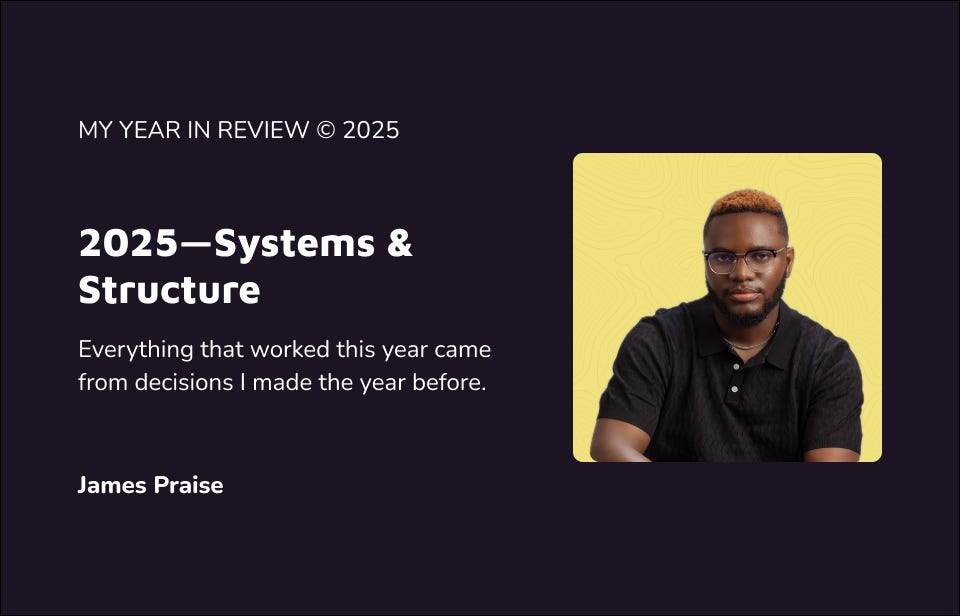
My name is James Praise, and I build, I write, I speak, and I teach. I share everything I know about productivity, marketing, and personal growth—templates, AI tools, handbooks, mental models, frameworks, and more. I mostly publish these in my newsletters—Marketing In Action, and RealTalk.
My annual reviews follow James Clear’s annual review template, which guides you through three key questions:
What went well this year?
What didn’t go so well this year?
What did I learn?
Here’s what I’ve been up to:
What went well this year?
I built extensive systems and structures across everything I do. This is of particularly high leverage, especially now that AI is more commoditized. AI is trained on data, and the best data is context-specific. That’s the hack.
Marketing In Action
Marketing In Action (MIA) started in 2024 as a marketing newsletter. Today it is evolving.
MIA is everything you need to put marketing into action. It is an execution-first marketing ecosystem that combines media, community, education, events, jobs, and consulting into one compounding system.
The wins so far:
Published 12 interviews with marketers, 5 marketing playbooks, 8 marketing case studies, and 10 product showcases.
Hosted our first virtual workshop (it was about AI, systems, and structure).
Launched the MIA Community and MIA Academy.
Collaborated with 2 brand sponsors.
Crossed 1,000 subscribers on the Substack newsletter, and 200 community members on WhatsApp.
James Praise’s Newsletter
This is where I share everything else that is not directly related to marketing. Everything you need for productivity and personal growth, all in one place.
The wins so far:
Published 11 newsletter issues, which is 7 more than I did last year.
Collaborated with the same brand sponsors from MIA newsletter.
Crossed 1,000 subscribers on the LinkedIn newsletter, and 400 on Substack.
Professional Learning
I set ambitious learning goals last year, and this year I executed. I said I was going to do it, and I did it. Didn’t I?

The wins so far:
I completed the PMA Scholar Program in April, and I am PMMC™ Product Marketing Certified.
I’m in my final semester of my MBA program at Miva University. I was also appointed student ambassador, and my grades are excellent.
Joined the AI GTM Engineering train, and very much more of a technical marketer than I was last year.

Community Engagements
These are some of the communities I’m actively involved in, besides my own community—Marketing In Action (MIA)—which I will still include anyway. This means I have engaged with these communities beyond just surface level-WhatsApp group chat conversations, but also physical meetups, and deeper member connections.
Marketing In Action by James Praise
Marketing for Geeks by Lade Falobi
Early Stage Marketer by Onyinye Nwankwo
Black Builders Network by Peace Itimi & Founders Connect
Clay Club Lagos by Sandra Uche
GrowthHackers Africa by Olumide Adaramoye
The Velocity by Eyitayo Ogunmola
Association of Digital Marketing Professionals (ADMARP) Nigeria
African Product Marketing Pioneers by Omolara Sanni
Product Marketing Alliance (PMA)
Some of these communities also engaged me for speaking engagements:
Engineering for Marketers by Feranmi Amos
Tech Sales & Partnerships Community (TSPC) by Titilope Macauley & Dara Ahmed
Gofigure by CareerBuddy
Smarketers Hub by Aisha Owolabi
Break Into Product Marketing by Olajumoke Adigun
MarTech Africa by Yournotify
I was also awarded one of Africa’s Top 20 Marketing Leaders of 2025 by APMP, and this was featured on Techcabal and Condia (formerly BenjaminDada).
I attended my first TEDx event this year, and am looking forward to being invited as a speaker next year. If you’re organizing an event, call me. I’m your guy.
Hiring & Delegation
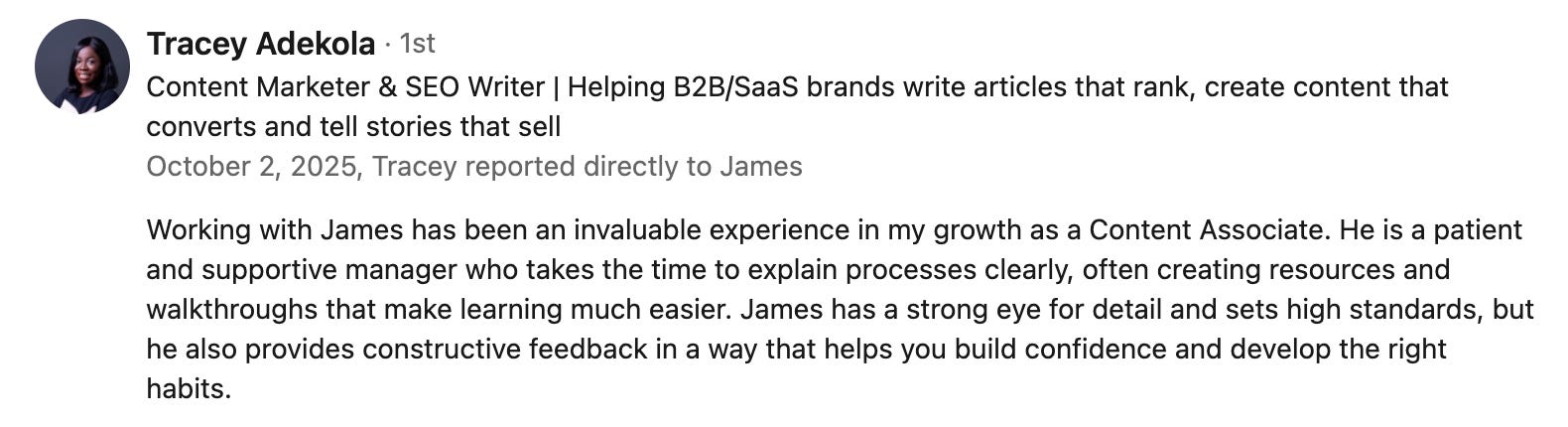
I’ve gotten better at this. I’ve built systems that make it easy for me to find, hire, and onboard people into my vision and projects. This has come with extensive documentation; knowledgebases, video guides, SOPs etc, and word from my team is that they love it.
Here’s feedback from some of my team members:

Finances
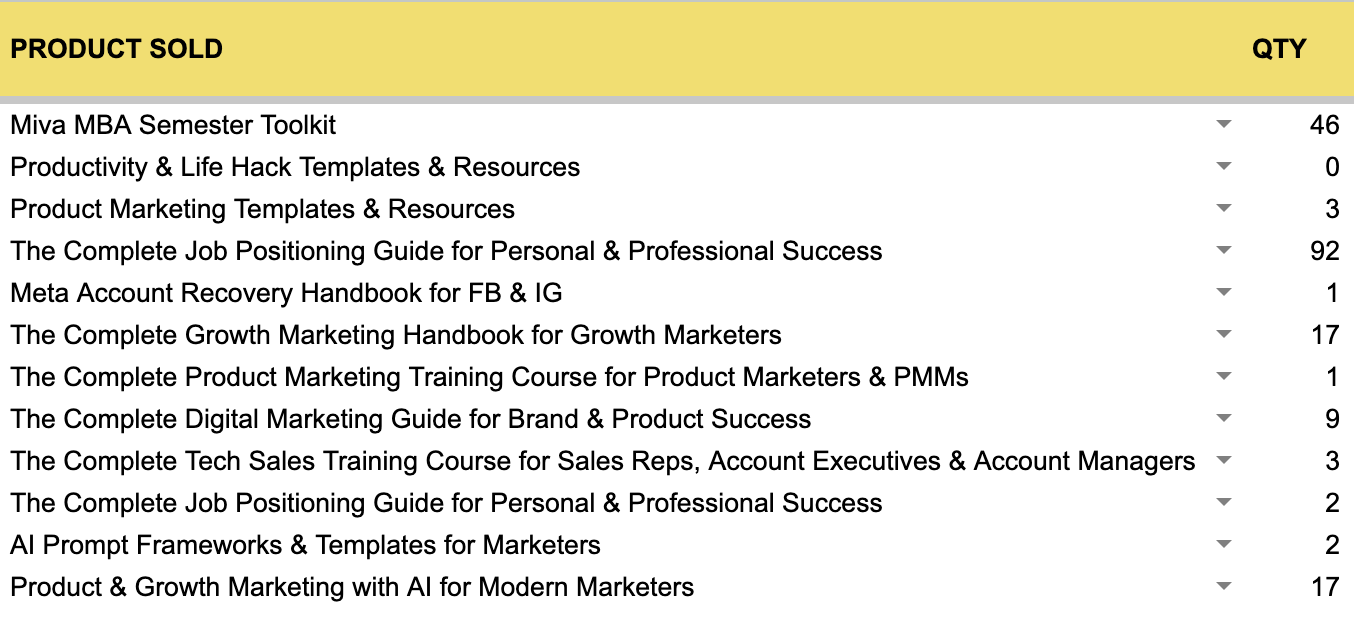
I diversified my income sources this year. Last year, I figured out how to; This year, I executed. The major clarity came from understanding my exit number (this is the amount of money that can cover your lifestyle if you had no job). I’ll write a detailed article about this soon.
The wins so far:
I tested and launched a number of digital products that did great numbers.
I applied my MBA learnings on finance, accounting and bookkeeping, which is now very useful in Tinubu’s tax regime.
I pitched for and got a raise at my full time commitment.
I onboarded 3 clients to my consulting business.
Romance
Nothing to tell you. Everything here is a win!
If you’re looking for relationship/marital advice, this article is still gold.
What didn’t go so well this year?
Books & Knowledge
I couldn’t keep up with my book-reading ambitions this year. There were too many other competing activities including school programs I ran in parallel. We go again next year, and I’ll take some notes.
Travel
Same as last year, I didn’t do much (or any) traveling this year and didn’t get to experience any new destinations or cultures.
Let’s see what happens in 2026.
Life Skills
I said I was going to learn swimming and professional videography last year.
I did not learn how to swim.
I did try to improve my knowledge and skills in professional videography, but I couldn’t consistently apply, because I got too busy with so many commitments throughout the year. I only managed to produce and publish a few videos. I also attempted to partner with a number of specialists in this area.
Healthy Living
Malaria is still my biggest health challenge, living in Nigeria, and all my research usually comes down to three focus areas: diet, drug, and lifestyle. Diet and drugs are not a struggle, but lifestyle is a tragedy. I work from home and sit on screens for 18+ hours a day. Physical activity is non-existent.
Again, my multiple commitments this year have made it difficult to stay fit, even with the systems I have tried to build.
Here’s a painful gist from my fitness journey:
I registered at a gym on May 2nd. I didn’t do much prep or research. That was intentional. I didn’t want to give myself room to procrastinate or overthink my way out of it. I just wanted to start.
At the gym, I asked an instructor to put me through a routine that fit my fitness goals. He wasn’t paying attention. He was more interested in the women at the gym than in what I was saying.
Eventually, he paired me with another guy at the gym. A more experienced gym bro. The kind that assumes everyone is starting from where he is. I followed his routine. It was long. It was tedious. It was clearly not designed for someone easing back into physical activity. After that, they also had me do intense cardio.
This was my first day back in a gym after living a largely sedentary lifestyle for over five years. A few hours after I got home, the pain started in my arms. At first, I assumed it was delayed onset muscle soreness (DOMS). The normal kind you expect when you haven’t used certain muscles in a while. It wasn’t.
The pain kept intensifying. By night, it was unbearable. I couldn’t sleep. It was the kind of pain that doesn’t let you find a comfortable position, no matter how you turn or stretch. That was when I realized something was wrong.
The next day, a Saturday, I went to the emergency unit of an orthopedic hospital. This is one of those moments where you are reminded, very quickly, why you don’t want to interact with the Nigerian healthcare system unless you absolutely have to.
The first doctor I met was a GP. He didn’t take me seriously. During the consultation, he was eating biscuits and drinking yoghurt. He spoke casually, dismissively, as if I was exaggerating. At some point, he started talking about witchcraft, superstition, and other nonsense I had no interest in entertaining.
He prescribed painkillers. Weak ones. The kind that do nothing for real pain. I took them anyway. They didn’t help. I pushed. I paid extra to fast-track a scan. I insisted on seeing an orthopedic specialist that same day, even though they kept telling me Saturdays were not appointment days for specialists.
Eventually, they agreed. The specialist was competent. He did what the first doctor should have done from the start. He diagnosed a rotator cuff tear. The medication he prescribed worked. The pain eased. I was put on medication and arm sling support, which I would wear for the next two months. It was absolute hell.
By the end of the year, I had completely changed my approach. I set up a home gym. Nothing fancy. Just utility. A bench, weights, dumbbells, barbells. Enough resistance to progress without chaos. I spent time learning properly this time. Fitness. Muscle building. Diet. Sleep. Metabolism. Supplements. What matters, what doesn’t, and what’s mostly myth.
I now manage my entire fitness routine using a custom-developed Notion system.
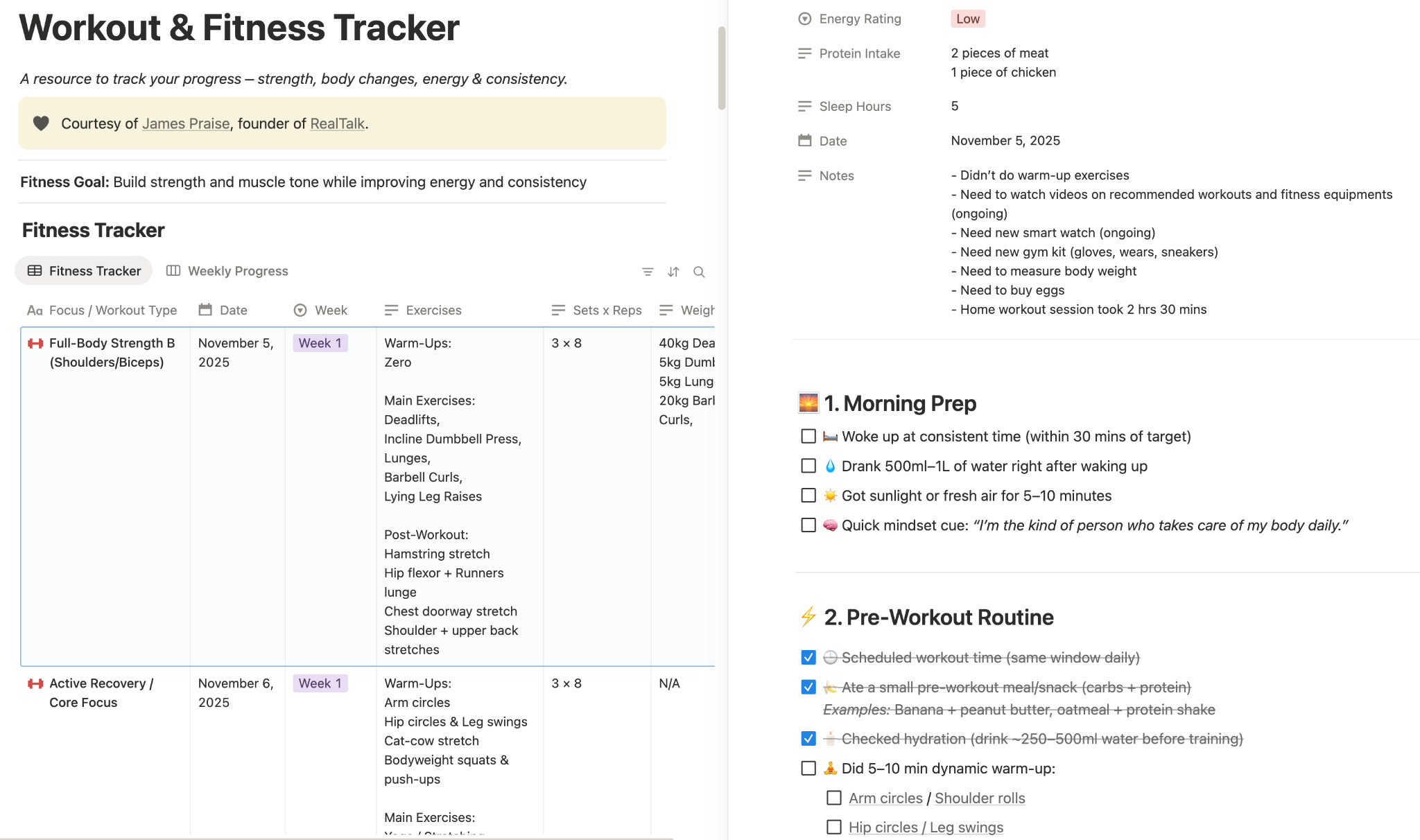
I might resume a gym sometime in the future when I max out all my weights at home. But, for now, we move. 10,000 steps a day.
What did I learn?
I am a student of life, whose mind can’t seem to quiet down. Everything I figure out, I tweet about.
1—If you don’t understand a system, it will look like fate.
People call things destiny when they lack the language to explain causality.
A child does not wake up as a full-grown adult. There are stages. Dependencies. Processes. Growth cycles. Life works the same way. When someone skips the understanding and jumps straight to the outcome, they label the gap “God’s will” or “grace” or “luck.”
Ignorance of process creates mythology.
2—Goals are wishes. Systems are commitments.
Goals describe what you want. Systems describe what you do.
A goal says “I want to be rich.”
A system asks “What inputs am I running daily that create money?”
Without systems, goals stay in prayer points and vision boards. With systems, outcomes become boring and predictable. The universe respects repeatable inputs more than emotional desire.
3—Nobody is coming to save you, and that’s okay.
This is not bad news. You have agency.
Once you accept that no manna is falling from the sky, something powerful happens. You start looking for levers. You stop waiting. You begin designing around constraints instead of complaining about them.
Agency begins the moment you stop expecting to be rescued.
4—Life is a compounding ledger of actions and inactions.
Nothing dramatic needs to happen for life to change. Things simply add up.
Missed learning compounds. Avoided conversations compound. Delayed decisions compound. So do skills. Relationships. Systems. Small choices repeated over time quietly lock in futures.
5—Financial success drives more decisions than we admit.
Strip away the noise and you’ll find money underneath most choices.
Education, entrepreneurship, japa, personal branding, content creation, even intense religiosity often trace back to one desire: financial security. Once you accept this, you get clarity.
6—Nigeria’s miracle economy exists because the guidance system is broken.
When people don’t know what to do, they outsource thinking.
Outdated curricula, poor career guidance, and missing roadmaps leave a vacuum. That vacuum is quickly filled by pastors, prophets, motivational speakers, and hustle gurus. Not because Nigerians are foolish, but because humans hate uncertainty.
7—Simulation theory explains why absurd outcomes keep winning.
Reality often behaves less like a moral story and more like a probability engine.
Simulation theory suggests that the most likely outcome is the most interesting outcome, and vice-versa. This explains why corrupt leaders outlive reformers, why bad news spreads faster than good news, and why nonsense often trends. It is just more interesting. Once you see life this way, you stop asking, “why would this happen?” and start asking, “why wouldn’t it?”
8—Most people don’t believe nonsense. They inherit it.
Very few beliefs are chosen consciously. Most are inherited at birth and reinforced before critical thinking ever develops.
By the time logic shows up, belief has already fused with identity. Questioning the belief then feels like questioning one’s parents, culture, or entire upbringing. That’s why people defend ideas that clearly harm them. They are not protecting truth. They are protecting belonging. Undoing inherited beliefs is not an intellectual exercise. It is an emotional and social risk.
9—Survival mode kills critical thinking.
A person who is hungry, scared, or desperate does not have the mental bandwidth for nuance or long-term reasoning. Survival compresses the mind.
When basic needs are threatened, everything else becomes negotiable. This is why systems that want control often keep people permanently exhausted, underpaid, insecure, and anxious. A calm, well-fed, well-rested population is difficult to manipulate. Fear narrows thought. Stability expands it.
10—People will defend suffering if it gives them identity.
Human beings crave meaning more than comfort. If suffering gives someone a sense of identity, purpose, or moral superiority, they will cling to it fiercely.
Many people defend painful systems because those systems answer a deeper question: Who am I without this? Leaving would mean losing community, status, certainty, and familiarity. So instead of asking whether something is harmful, people ask whether it still makes them belong. Pain that gives identity is often protected more aggressively than freedom that brings uncertainty.
🗄 See my annual review archives here
How was 2025 for you?
Systems + structure matter more than ever as teams scale. Leaders who embed strategic learning, cross-functional process, and disciplined ops win not just visibility but velocity.